
Advances in Leukemia Detection and Monitoring
Progress in leukemia testing involves several complementary methods. The useful question is what each method measures, where it has been evaluated and how its findings fit with the rest of the clinical record.

Different tests answer different questions
Microscopy examines cell appearance. Immunophenotyping investigates cell markers. Genetic tests identify relevant chromosome or gene changes. These methods can contribute to identifying and characterizing leukemia, alongside clinical assessment and other laboratory findings. [1]
New technology therefore does not automatically make an established test redundant. A comparison must consider the intended use and the information that would be lost if one method replaced another.
Measurable residual disease
Measurable residual disease, or MRD, describes disease detected using sensitive methods beyond a conventional remission assessment. The European LeukemiaNet's 2021 AML consensus addresses flow cytometry and molecular approaches, emphasizing sample selection, testing time points, technical methods and reporting. It is a foundational reference, not a universal protocol for every leukemia subtype. [2]
For a research reader, an MRD claim is incomplete without the assay, specimen, marker and time point. Results from different methods should not be treated as interchangeable.
Liquid biopsy is an active research area
Hupe and colleagues studied plasma cell-free DNA in a small cohort with isolated extramedullary AML. Their findings support investigation of molecular monitoring in that specific setting. They do not establish that a blood-based assay can replace all marrow examinations across leukemia care. [3]
This distinction helps keep promising research visible without overstating its readiness for every patient or application.
Digital imaging and computational methods
The SGLNet study investigates detection within bone marrow microscopy images rather than only classification of isolated cell crops. It illustrates why evaluation should specify whether the unit is a cell, image, slide or person. These units answer different questions and produce different measures of performance. [4]
How to read an advance critically
When evaluating a new method, ask:
- What clinical or research question does it address?
- What material and reference standard were used?
- Were samples from independent patients and institutions tested?
- What remains unmeasured, including workflow effects and outcomes?
CellSight follows this field as part of its interest in evidence-connected blood-cell image research. This overview describes external methods; it does not state that CellSight performs molecular testing, MRD assessment or clinical diagnosis.
References
- 1. Diagnosis of leukemia. Canadian Cancer Society. Undated current page. Accessed 2026-09-14.
- 2. 2021 Update on MRD in acute myeloid leukemia: a consensus document from the European LeukemiaNet MRD Working Party. Heuser et al., Blood. 2021-12-30. Accessed 2026-09-14.
- 3. Cell-free DNA for detection and monitoring of extramedullary AML relapse. Hupe et al., HemaSphere. 2025-03-10. Accessed 2026-09-14.
- 4. High-efficiency spatially guided learning network for lymphoblastic leukemia detection in bone marrow microscopy images. Mei et al., Computers in Biology and Medicine. 2025-08-02 online; September 2025 issue. Accessed 2026-09-14.
Related Insights

Liquid Biopsy in Leukemia: Promise and Limits
Explore liquid-biopsy research in leukemia, what plasma cell-free DNA may reveal, and why evidence from a defined setting cannot replace every marrow test.
By CellSight Editorial Team · September 13, 2026 · 2 min read
Read article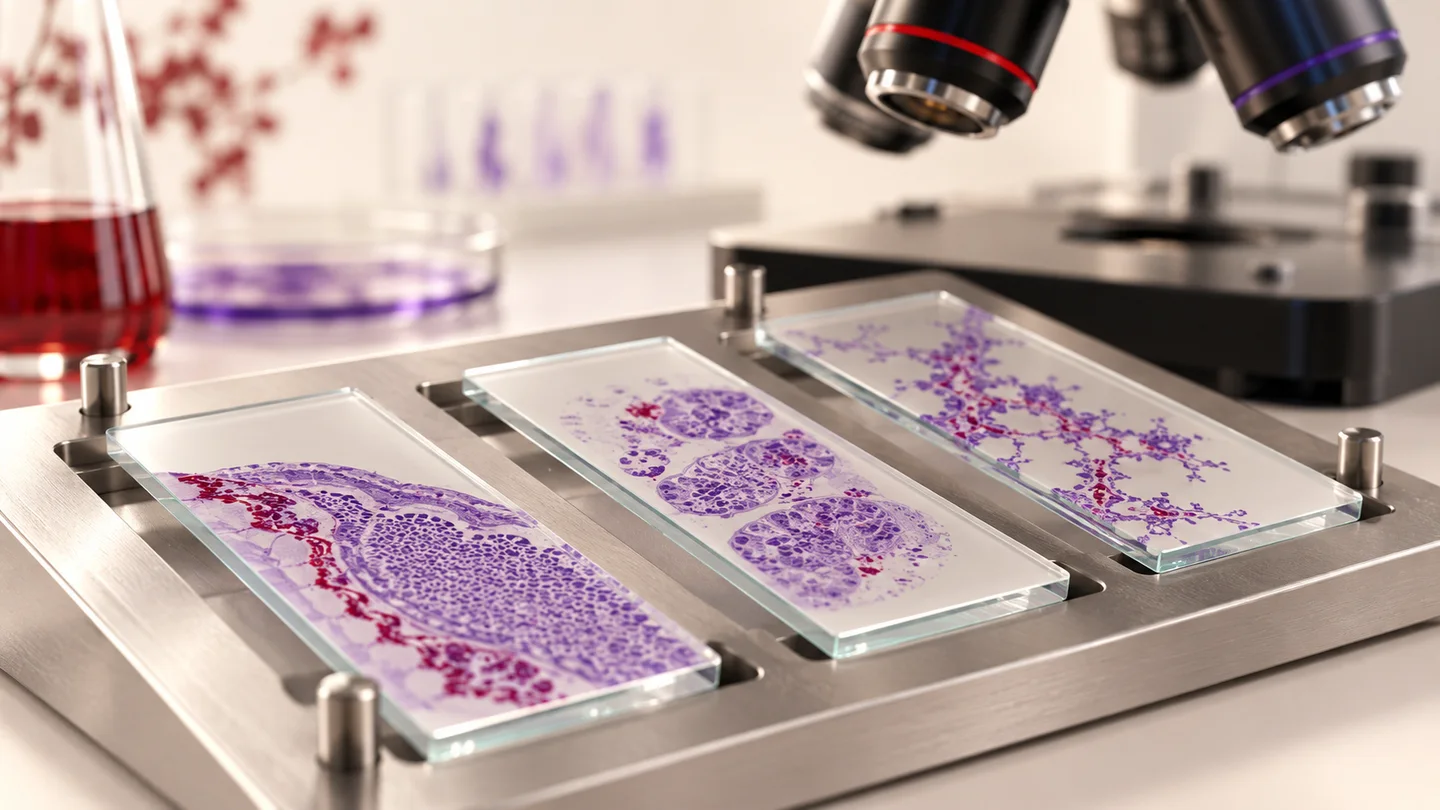
How AI May Support Faster Leukemia Investigations
Consider where AI may assist leukemia investigations and why processing speed, review time and the time to a clinical diagnosis must be measured separately.
By Dr. Nafiseh Memar Kermani · September 13, 2026 · 2 min read
Read article
Designing traceable AI image workflows
How identifiers, metadata and timestamps turn a microscopic image workflow into something that can be reviewed later.
Read article